
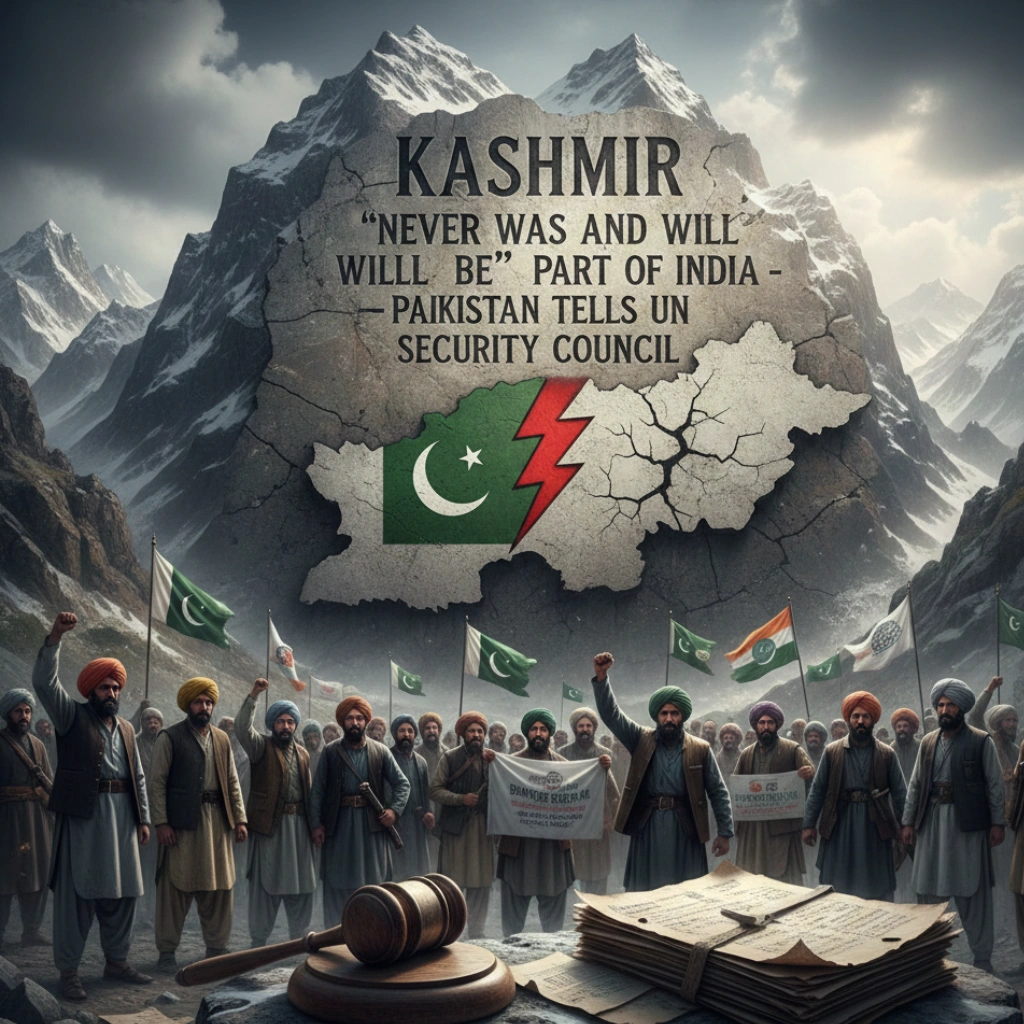

Kashmir 'never was and never will be' part of India, Pakistan tells UN Security Council
Kashmir and the United Nations: Pakistan’s Stand and the Unfinished Question
The Kashmir dispute remains one of South Asia’s most enduring and emotionally charged conflicts. Decades after the subcontinent’s partition, the issue continues to echo through diplomatic halls, most recently at the United Nations Security Council, where Pakistan reiterated its long-held position: Kashmir, it argues, “never was and never will be” a part of India.
This statement is not new, but its repetition on a global platform underscores how unresolved the conflict remains—and how deeply it shapes regional politics.
A Dispute Rooted in History
The origins of the Kashmir conflict date back to 1947, when British India was divided into two independent states, India and Pakistan. Kashmir, a Muslim-majority region ruled at the time by a Hindu monarch, became contested almost immediately. Competing claims, wars, and ceasefire lines followed, leaving the region divided but unresolved.
For Pakistan, Kashmir represents an unfinished agenda of partition and a question of self-determination for its people. For India, it is viewed as an integral part of its sovereign territory. These opposing narratives have hardened over time, leaving little room for compromise.
Pakistan’s Position at the UN
By raising the issue at the UN Security Council, Pakistan seeks to internationalize the Kashmir dispute. Its argument rests on United Nations resolutions passed in the late 1940s, which called for a plebiscite to allow the people of Kashmir to decide their future. Pakistan maintains that these resolutions remain unimplemented and legally relevant.
The assertion that Kashmir “never was and never will be” part of India is meant to challenge India’s constitutional and administrative control over the region, especially after New Delhi’s 2019 decision to revoke Jammu and Kashmir’s special status. Pakistan views that move as a violation of international law and a threat to regional stability.
India’s Counter-Narrative
India, however, firmly rejects any third-party involvement, calling Kashmir a purely internal matter. It argues that the region’s accession in 1947 was legal and final, and that constitutional changes were an internal administrative decision. From New Delhi’s perspective, Pakistan’s statements at the UN are seen as attempts to deflect attention from cross-border tensions and internal issues.
This diplomatic deadlock ensures that international forums hear strong words—but see little progress.
The Human Cost Often Overlooked
Lost amid legal arguments and political rhetoric are the people of Kashmir themselves. Decades of militarization, political uncertainty, and restricted civil liberties have taken a heavy toll on everyday life. While states argue over maps and mandates, ordinary Kashmiris continue to live with the consequences of a conflict they did not create.
Any meaningful discussion of Kashmir’s future must move beyond absolutist claims and address human rights, economic opportunity, and political voice.
An Issue Far from Resolution
Pakistan’s statement at the UN Security Council serves as a reminder that Kashmir is not a closed chapter in international politics. Despite shifting global priorities, the dispute remains volatile, with implications for peace between two nuclear-armed neighbors.
Until dialogue replaces declarations and diplomacy focuses on people rather than positions, Kashmir will continue to resurface on global stages—unresolved, contested, and deeply symbolic of South Asia’s unfinished history.